

Contents:
Academic publications
Swaine, Aisling. Swaine, A. (2026). Conflict-Related Coercive Control: A Framework for Understanding Women’s Experiences of Group-Based Coercive Control in Conflict-Affected Settings. Violence Against Women, 0(0).
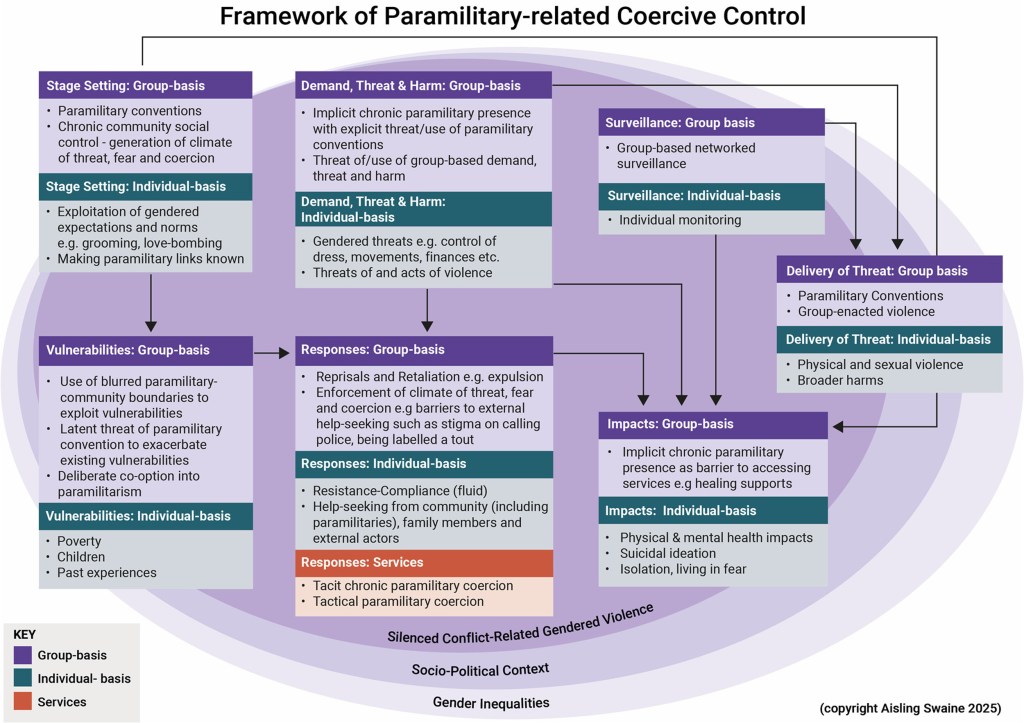
This paper presents a new “Framework of Paramilitary-related Coercive Control.” Based on empirical research in Northern Ireland, the paper evidences how coercive control can be used as an analytical lens to approach understanding of armed-actor-related intimate-partner violence, as well as being a form of conflict-related harm. The paper advances the concept of “conflict-related coercive control,” showing how the predatory nature of armed group social control is the basis for the endemic gendered control of women. It expands the study of intimate partner-based coercive control towards group-based control of women, and by so doing, expands the concept of social control, evidencing the gendered nature of armed group governance.
Attribution: The author disclosed receipt of the following financial support for the research, authorship, and/ or publication of this article: This research was funded by The Reconciliation Fund of the Department of Foreign Affairs, Ireland and was initially published as a policy report as follows: Swaine, Aisling. When you know what they are capable of: Paramilitary-related Gendered Coercive Control (Foyle Family Justice Centre, University College Dublin, 2024). Further research, analytical work and development into this journal article was funded by a European Research Council Consolidator Grant [GENCOERCTRL agreement no. 101088427].
Swaine, Aisling. Resurfacing Gender: A Typology of Conflict-Related Violence Against Women for the Northern Ireland Troubles. Violence Against Women. 2023, 29(6-7):1391-1418.
The “Troubles” in Northern Ireland are often assumed to represent an outlier in respect of contemporary global discourse on conflict-related violence against women (CRVAW), and particularly “strategic rape.” CRVAW has neither commanded the narrative nor imagery of that conflict nor specifically recognized globally as part of women’s experiences of it. A composite and comprehensive analysis of CRVAW for that context has been absent. Based on primary and secondary research, and analytically advanced through gender and critical harm theory, the article presents the first typology of CRVAW for the Northern Ireland Troubles. The article maps and evidences a range of gendered harms directly and indirectly resulting from the conflict enacted by state and nonstate actors. It argues that a resurfacing of gender is required to ensure current global debates on CRVAW are informed by a reconsideration of what constitutes “strategic” harm in armed conflict.
Policy publications
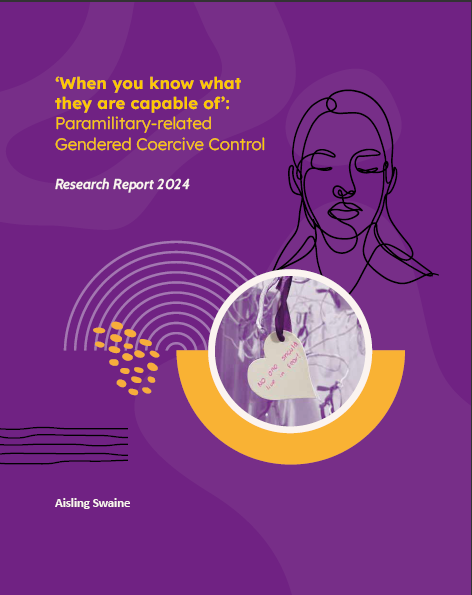
Policy report: ‘When you know what they are capable of‘
‘When you know what they are capable of’: Paramilitary-related Gendered Coercive Control, by Aisling Swaine in association with Foyle Women’s Aid, Foyle Family Justice Centre, UCD Sutherland School of Law, & the Department of Foreign Affairs Reconciliation Fund. This report advances the idea ‘conflict related coercive control’ and adapts the concept of coercive control to examining how women’s experiences of IPV are influenced by paramilitarism in Derry/London Derry in Northern Ireland. Research report launched at an event in Derry/Londonderry on 16th September, 2024.
 Coercive In/Justice